
About this report
The report, ‘Social inequalities in health in the EU’, was written by EuroHealthNet, in collaboration with the Centre for Health Equity Analytics (CHAIN).
Based on the latest comparable data from across Europe, this report confirms both the scale of health inequalities and the social and economic forces driving them. These health gaps undermine our shared European values, weaken economic competitiveness, and reduce resilience in the face of geopolitical and environmental crises.
This report sets out clear, evidence-based actions to close these gaps, strengthening Europe’s cohesion and making good health a reality for all, not a privilege for the few. The purpose of this report is to raise awareness and provide evidence of social inequalities in health as a key priority for EU and national policies, as well as to identify areas where EU and national action on social inequalities in health is feasible and needed.
What are social inequalities in health?
Europeans are living longer than ever before, with an average life expectancy of 81 years. But averages hide stark inequalities. Those with lower incomes or less education are less likely to live a long, healthy life.
Europeans are living longer than ever before, with an average life expectancy of 81 years. But averages hide stark inequalities. Those with lower incomes or less education are less likely to live a long, healthy life.

Health inequalities are differences in people’s health that are linked to social disadvantage.
They are caused by obstacles to health such as poverty, discrimination, lack of power, and unequal access to the resources that help people stay healthy. These include fair jobs, safe environments, quality education, housing, healthcare, and social support. These factors are called the social determinants of health.
Living longer does not mean living healthier
A child born in Spain today can expect to live to 81.4—over eight years longer than a child born in Bulgaria, where life expectancy is just 75.8 years. Even within countries, people in lower socioeconomic groups are twice as likely to report poor health compared with those in higher socioeconomic groups. The higher someone’s position in society, the more likely they are to live a long and healthy life, a pattern known as the social gradient in health.

Health inequalities are differences in people’s health that are linked to social disadvantage.
They are caused by obstacles to health such as poverty, discrimination, lack of power, and unequal access to the resources that help people stay healthy. These include fair jobs, safe environments, quality education, housing, healthcare, and social support. These factors are called the social determinants of health.
What drives social inequalities in health?
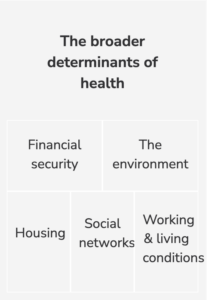
Many of the factors that influence health lie outside the healthcare system itself. Healthcare explains only about 10% of health differences. The rest stem from broader structural factors
These reflect deeper inequalities in power and opportunity. They shape the conditions in which people live and restrict the choices available to them.

A wider systems problem
Political and economic systems influence these structural factors and determine how resources are shared fairly. These systems set the rules for taxation, minimum wages, social welfare, and commercial activity.
This is why reducing health inequalities requires more than health policies alone. It demands a systemic approach, leadership, and
coordinated action across sectors.