Introduction
Health at a Glance provides a comprehensive set of indicators on population health and health system performance across OECD Members, Key Partners and accession candidate countries. These indicators cover health status, non-medical determinants and health risk factors, access to and quality of healthcare, health spending and health system resources. Analysis draws from the latest comparable official national statistics and other sources.
Alongside indicator-by-indicator analysis, an overview chapter summarises the comparative performance of countries and major trends. This edition also includes a thematic chapter on gender and health.
Countries have largely recovered from the pandemic, but fundamental health challenges remain
Life expectancy has recovered and is on an upward trajectory, but remained below pre-pandemic levels in 13 countries in 2023.
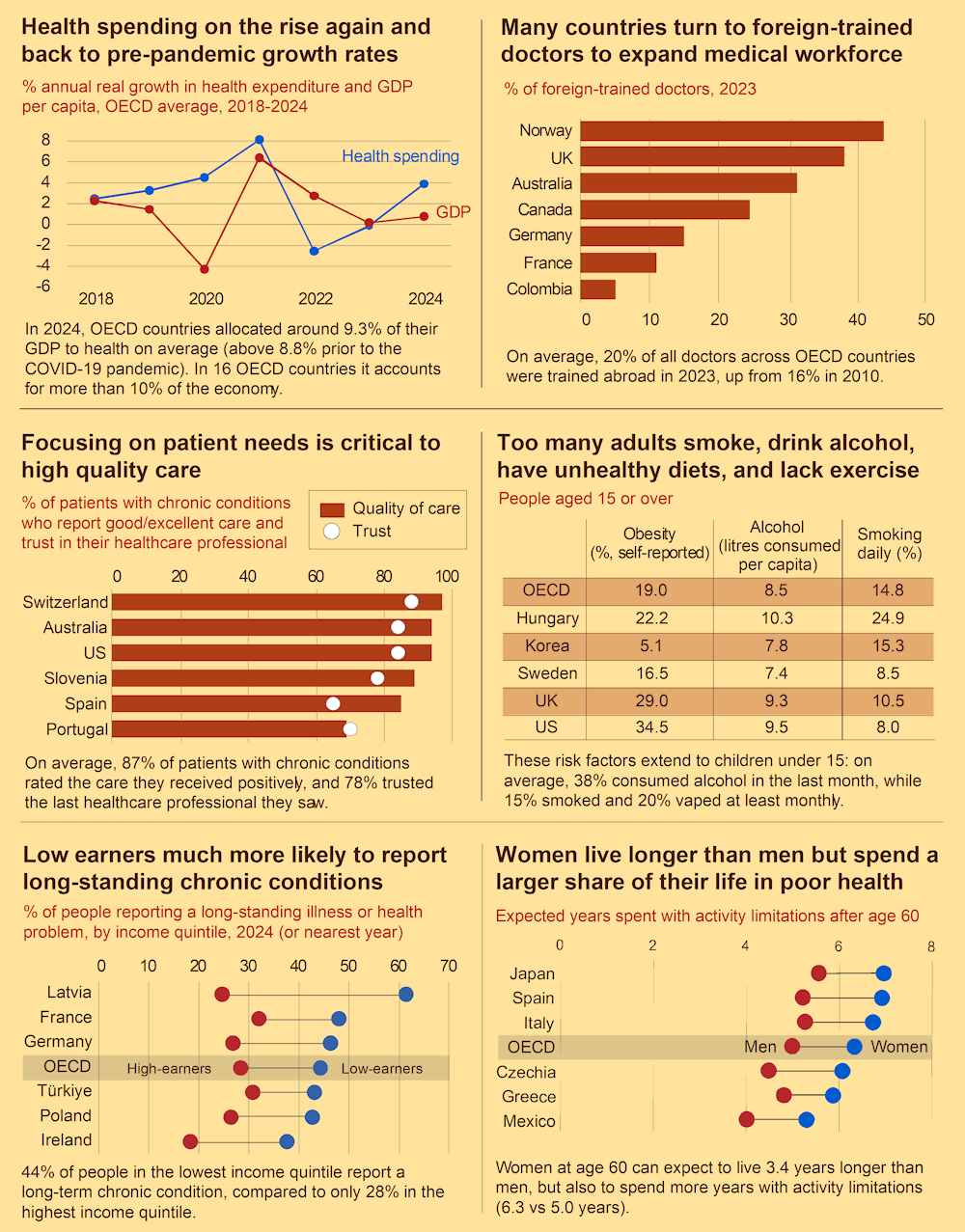
Combatting health risk factors throughout life is key to achieving long-term health gains at low cost. Yet obesity rates continue to rise in most countries, and harmful alcohol use and smoking remain major public health concerns, for adults and children alike.
Health systems account for around a tenth of economic output and employment
In 2024, OECD countries allocated on average 9.3% of their GDP to health. This is down from the peak reached during the COVID‑19 crisis, but higher than pre‑pandemic levels.
Also, about one in every nine jobs across OECD countries is in health or social care. Both health spending and the health workforce are expected to continue to increase further, driven largely by technological change, rising expectations of what healthcare can achieve, and ageing populations.
A renewed focus on value-for-money is essential
Many preventive healthcare interventions are highly cost-effective, particularly in addressing risk factors to health, such as obesity, smoking and harmful alcohol use, that drive up healthcare costs in the longer term. Yet despite spending on prevention increasing to 6% of total health expenditure during the COVID-19 pandemic, it returned to historical levels of 3% in 2023.
Using health resources more efficiently is also key, including an expanded use of digital health innovations such as doctor teleconsultations.